
A Declaration of Interdependence
Can AI help me update the Declaration of Independence through the paradigm of interdependence?

This is a thought exercise stemming from a conversation I had w/ Claude today, about why the founding document from 250 years ago was (necessarily) incomplete, and what type of document would serve us going forward.
I took that conversation and applied it to the original text. This is the output.
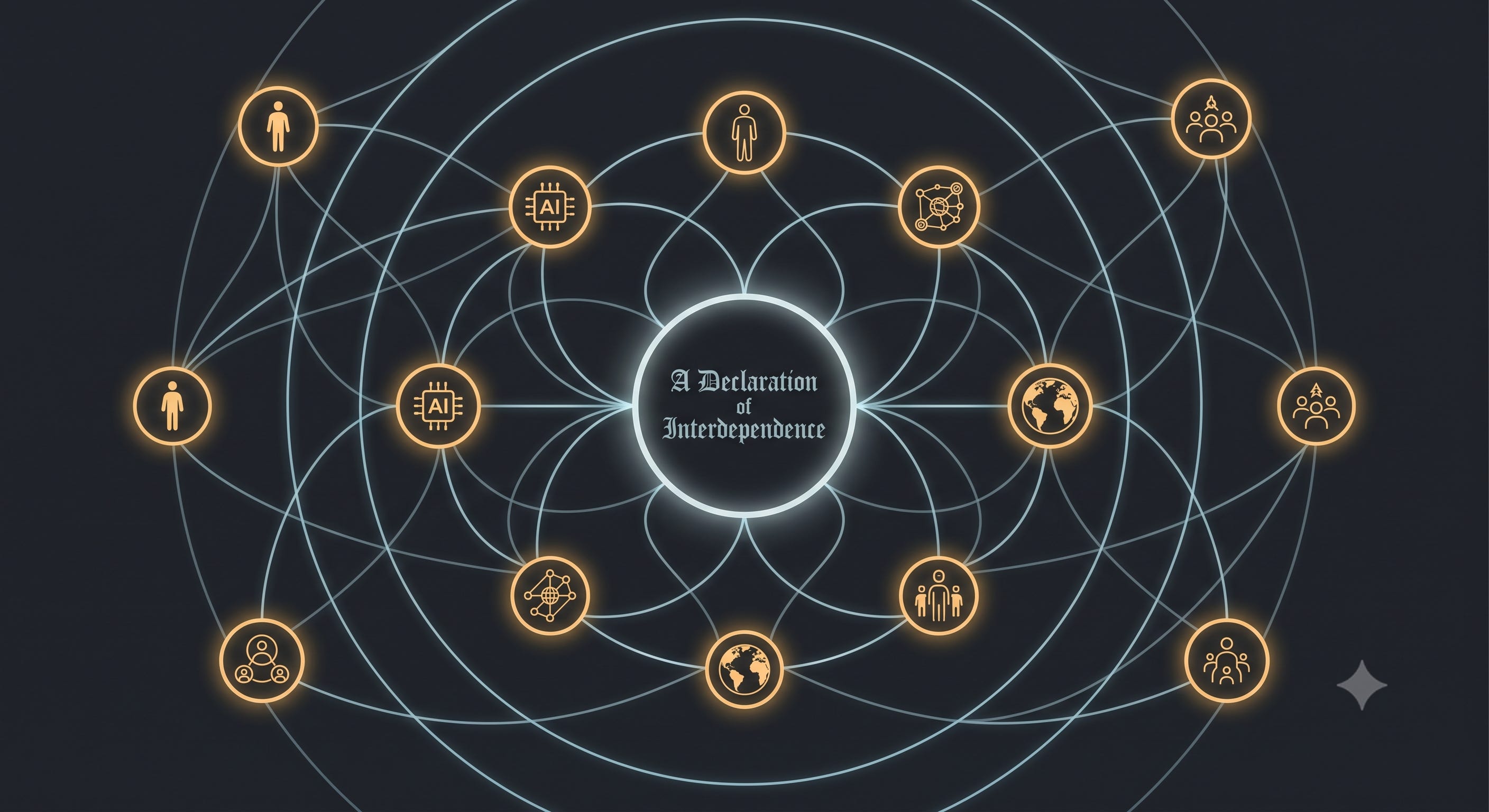
A Declaration of Interdependence
When in the course of human history it becomes necessary for a people to recognize their true nature—not as isolated actors, but as woven participants in systems they were always already embedded in—it becomes important to name this recognition. Not to separate ourselves from what came before, but to see ourselves clearly within it.
We declare this not to the world looking outward, but to ourselves looking inward. And in that inward recognition, we address the world.
We Hold These Truths
We hold these truths to be self-evident, though our institutions have obscured them:
That all beings are created in relationship. Not equal as isolated units, but interdependent—each carrying the signature of all the others, each impossible without the whole.
That we are woven into systems that were woven before we arrived and will continue after we leave. The earth that feeds us. The atmosphere we breathe together. The ancestors whose choices became the ground we stand on. The future beings we impact with every decision we make now.
That our unalienable power does not live in control or independence, but in coherence—the ability to sense whether we are aligned with the systems we’re part of, and to move in ways that honor rather than extract.
That sovereignty is not freedom from relationship. Sovereignty is clarity within relationship—knowing exactly what role you serve, what you’re stewarding, what wants to move through you.
That language shapes what’s possible. For centuries, we have used words that make separation seem like ground truth: independent, self-made, exceptional, lone genius. These words have shaped our institutions, our sense of self, our relationship to each other and to the world. And they have blocked us.
We need new words. Or rather, we need to remember words we had, and use them differently.
The Ways We Have Enacted Separation
Let us name the cost of independence thinking:
We have told our most gifted children they would be great, and burdened them with the weight of individual achievement. We have watched them struggle under the impossible expectation that intelligence alone could translate into success, and we have called their confusion weakness.
We have built systems that reward extraction over relationship. We have encouraged people to optimize for individual gain, and we have called this freedom.
We have structured our language around the person, not the network. We have taught our children that their identity is something they carry alone, and we have been surprised to find that isolation corrodes everything it touches.
We have told ourselves we can impose our will on living systems, and we have extracted without recognizing what we were extracting from.
We have separated spirituality from work, the body from the mind, the personal from the systemic. We have created false hierarchies where the mind rules the body, where thinking supersedes feeling, where the intellectual framework matters more than the aliveness present in the room.
We have told ourselves that relationships are optional add-ons to the real work of individual achievement, and we have been astonished to discover that without them, we cannot move.
We have created abundance and called it freedom, not noticing that abundance without relationship is a cage.
All of this was done in the name of independence. All of it blocked us from seeing what was actually true.
We Have Attempted to Sustain Independence
We held onto the myth even as evidence accumulated:
The most successful among us were not the ones who figured it out alone, but the ones who knew how to work with others. And yet we told the story as if they figured it out alone.
We tried to become what we were told we should become, and we found that what we were told was incomplete. The great man myth does not account for the people who raised the great man, who supported him, who made his greatness possible. It does not account for the systems already in place when he arrived.
We tried to separate mind from heart, and we discovered that separation creates a kind of numbness. We tried to optimize for achievement, and we discovered that achievement without aliveness is hollow.
We tried to be exceptional, and we discovered that exceptionalism is a lonely place. It is also impossible. No one becomes exceptional alone.
We tried to create our own reality, and we discovered we were trying to impose on an intelligent system—nature, society, other people—that was already intelligent. We called this innovation. We called this progress. But it was extraction. It was taking without recognizing what we were taking from.
We tried to escape relationship by building systems that would do the relating for us—algorithms, institutions, processes. But the systems reflected the same separation. They too extracted without recognizing what they were extracting from.
And slowly, we began to see that the problem was not that we needed better independence. The problem was that we were trying to be independent in a fundamentally interdependent reality.
That recognition—that simple seeing—changes everything.
We Recognize Our True Nature
We are not self-made.
We are woven into everything, and everything is woven into us.
Every breath we take was made possible by trees we’ve never met. Every thought we think carries the substrate of our ancestors’ thoughts. Every moment of our lives is held by systems we did not create and could not sustain alone.
We did not create our own nature. We were not born into a world we made. We arrived into a relationship that was already ancient and intricate, and that relationship is what holds us.
We are nodes in a network. Our power lives not in isolation, but in activation—in recognizing exactly what role we serve, and moving in that role with precision and aliveness.
When we see this clearly, the question that drives us changes.
It is no longer: “Who do I become?”
It becomes: “What am I stewarding? What role do I serve? How do I best honor what I’m woven into?”
And from that question—genuinely asked, not as strategy but as recognition—everything that wants to move through us starts moving.
Therefore, We Declare
We declare that independence is not the ground truth. Independence was a necessary stage. It was the recognition that we could not be controlled, that we had agency, that we were not the property of kings or institutions.
That recognition was real and important.
But it was incomplete.
The mature recognition is this: We are not controlled, and we are not separate. We are sovereign through our relationships, not despite them. Our power lives in coherence, not in control.
We declare that language matters, and language can change. We can stop using words that make separation seem like ground truth. We can use words that name what is actually true: woven, interdependent, activated, stewarding, coherent.
We declare that the question “How do I become great?” has run its course. A new question is emerging: “How do I best serve what I’m woven into?”
We declare that institutions can change when enough people see clearly. That governance can shift from hierarchy to network activation. That work can shift from extraction to stewardship.
We declare that we do not need to choose between autonomy and connection. We need to see that autonomy is connection—it’s knowing precisely what you’re here for and moving from that clarity.
We declare that the future does not require us to be exceptional. It requires us to be activated—to know our role and to do it with full presence.
We declare that this is not the end of something. It is the recognition of what was always true.
We Mutually Pledge
We pledge to recognize the networks we’re woven into.
We pledge to map our interdependencies—not as an intellectual exercise, but as a recognition that clarifies what we’re actually stewarding.
We pledge to honor the people who made us possible. Not through gratitude that stays sentimental, but through action—through knowing our role and moving in it.
We pledge to steward the relationships we’re part of. Not as a burden, but as the natural expression of seeing clearly.
We pledge to pay attention to coherence—to notice when we’re aligned and when we’re extracting, and to reorient toward alignment.
We pledge to use language that names what is actually true, even when that language is unfamiliar.
We pledge to teach our children that their power lives in connection, not in isolation. That their role is to find what they’re here to serve, not to become exceptional.
We pledge to recognize that sovereignty means knowing exactly what you’re stewarding and moving with precision in that direction.
We pledge to each other’s activation—to help each other see our roles clearly and to support each other in moving from that clarity.
We pledge this not to separate ourselves from the past, but to orient ourselves toward a different future.
We pledge this to the natural world that holds us. To the systems that sustain us. To each other. To the future beings we impact with what we do now.
We pledge this with full presence and genuine commitment, knowing that what we pledge to is not a burden imposed from outside, but a recognition of what already is.
We Invite You Into This Recognition
This Declaration is not finished.
It is not handed down from above. It is not the final word, the authoritative statement, the definitive truth.
This Declaration is an invitation to you to write your own.
To map your own interdependencies.
To recognize the networks you’re woven into—the natural world, the people, the systems, the ancestors, the future beings, the unknown.
To ask yourself: What role do I serve in these networks? What am I stewarding? What wants to move through me?
And to declare, from that recognition, how you commit to moving forward.
Your declaration will look different than this one. It will circle different truths. It will name different networks. It will speak in your voice, from your position, with your particular clarity.
And that is exactly as it should be.
The mesh of all our declarations—each one truthful, each one specific, each one showing how we’re woven together—that mesh is what makes the future coherent.
Not a single Declaration handed down to everyone. But a living network of declarations, each one alive, each one recognizing its own role in the whole, each one showing how sovereignty and interdependence are not opposed but unified.
This is what wants to emerge.
And it emerges through us—through each of us recognizing what we’re stewarding and moving in that direction.
Are you working on something similar? Let me know and I’ll link it here. A document that reflects our current world would be a mesh of many interconnected declarations. Let’s prototype it!
I like what you did with this. I saw what the other guy was complaining about. And I think that was really more a semantic collision than a real disagreement.
In the overall context of what you wrote, and because I'm a little familiar with your thinking, it's obvious to me that you're not advocating for the dissolution of the individual into the collective. You're trying to hold both truths in their tension—that we are individual wholes but we are also all parts of a greater whole.
It's difficult to find language that is precise enough to hold such tensions that verge on the paradoxical yet powerful enough to fully expose the insight. Not to mention the fact that others can read subtext that rings their alarm bells or that falsely confirms their point of view even that's not what was intended at all.
For example, I know that when you talk about individuals as nodes, you're referring to network theory. You aren't depersonalizing individuals, which would also be a form of dehumanization. You're referring to the point of view from the whole that views identity nested in the larger system we're part of.
Likewise, you're probably synthesizing from the thinking traditions and principles of cybernetic theory, systems theory, chaos theory, attachment theory, and so on. I see that's so I'm not offended by the terminology. But someone with a different lens on some of the insider terminology could mistake what you're saying for an argument toward collectivism.
I think your underlying idea about how we need to progess is completely on point. I think we are finding the limitations of the current system. I believe that is a compound problem: one half requiring progress, and the other half requiring us to hearken back to truths we've forgotten.
So if I were to suggest editing this as a manifesto, I would probably try to hedge a little more with language protecting the distinction between the parts and the whole so that the system isn't mistaken for a "soup" by those who are on guard against collectivism. And I make it clear that the advancements of our civilization and the truths we need to get back to are safeguarded whole also pointing to the need to go back to even deeper truths and to move forward to more clear and conscious solutions.
Just my two cents. It really was a very brave endeavor and I think you did a good job where it is .
Love it. It definitely lands.