
Coherence in a Time of Collapse
Substack, Emergence, and the Mycelial Network of the Parallel Reality

As a child, I had intuitive access to something—in the moment it felt like flow, life force, coherence. I can’t call it a belief, because it was more like a knowing. In my mind, I sensed a world that was fundamentally possible.
I wrote sci-fi stories about utopian futures because I was imaginative, and because this type of perception could only be expressed in the world of fantasy. But to me, it was real.
Then I became an adult.
Life was not what I thought it would be. The patterns broke. The coherence became fragmented. At 15, clinical depression arrived and it stayed for 20 years. Even though my intelligence was consistently validated, the world had no place for my real perception. I was liked, but I didn’t belong. And somewhere in those two decades, I forgot how to access what I had known—that intuitive knowing of what was possible.
But I never forgot it.
Even when there was no reason to hope. Even when depression told me I was delusional. Even when my ego got smacked down over and over, and I felt like a passenger in a world that was spinning toward collapse.
For a long time, I thought it was just me. I wanted my life to always feel the way it had felt as a child. Like I had access to magic. I chased law of attraction, personal transformation, anything to reclaim that feeling. But somewhere along the way—maybe when my ego had been humbled enough, maybe because my brain can’t not fractalize, maybe because I selfishly would enjoy it more—the wish expanded.
I want to live in a world where everyone has access to that coherence.
And then something else happened. The illusion of consensus reality started actually dissolving. And the emergence of new paradigms began to sprout.
And I realized: I didn’t imagine this, or imagination isn’t what I thought it was - what we’ve been taught to believe. The childhood knowing wasn’t delusion. It was a kind of prescience. I was sensing a frequency that was actually coming interpreted through possibility branches in my brain. And I’ve been holding onto it all this time not because I was stubborn or delusional, but because some part of me knew it was real. And it was worth holding onto. Immensely worth it.
Now the world is waking up. Painfully. Terrifyingly. And I have to tell you what I see, because if I don’t, I’m betraying the part of me that never let go, even when it cost me dearly.
The Painful Waking: Why It Feels Insane (And What That Actually Means)
Here’s what nobody tells you about spiritual awakening: it doesn’t have to, but, it tends to feel insane because you’re waking up in a culture with no container for it besides mental illness.
What I learned through working for a shaman, learning to guide people is that - in traditional cultures, there were rituals for this. Vision quests. Initiations. Shamanic journeys. There were elders, guides, witnesses. The process was supported, held, normalized. In other words, we had community.
We don’t have that anymore, unless you count dogmatic religions, who use community to suppress, redirect, or control the spark.
Instead, you’re waking up alone in a culture that is actively invested in keeping you asleep.
The destabilization you’re feeling—that sense that reality is warping, that you’re perceiving things others can’t see, that you might be going crazy—that’s most likely not a symptom of mental illness. That’s what happens when you start to perceive the paradigm you’ve been living in. You can’t unsee it once you see it. Your entire sense of reality has to reorganize around this new perception. Of course it feels insane. You’re losing your old identity without a new one yet.
And it’s not just you: many people would rather you didn’t wake up.
Systems of power depend on your compliance. If you’re asleep, you engage with extractive systems, you accept the narratives you’ve been fed, you participate in your own limitation. When you start to wake up, you stop doing those things. You refuse. You question. You see the game. And that makes you a threat—to the system, to the people invested in it, to everyone still asleep who needs your compliance to justify theirs.
So you get gaslit. People tell you you’re overthinking. You’re being dramatic. You’re too sensitive. You should just accept how things are. Take medication. Get therapy. Stop being so weird. All of these messages—some well-meaning, some not—are the culture’s way of trying to pull you back into sleep.
If you’re feeling destabilized right now, that’s not a sign something is wrong with you. That’s increasingly likely a sign something real is happening.
Your perception is shifting. The paradigm is cracking. You’re seeing things you can’t unsee. That should feel destabilizing. It should feel like you’re losing your mind, because in a way, you are—you’re losing the mind that accepted the old paradigm as truth.
This is why healthy spiritual initiation requires community. Not isolation. Not self-help books or meditation apps. You need other people who are also waking up. You need witnesses. You need support structures that hold this process as sacred, not pathological.
You need to know you’re not alone in feeling like you’re going insane. You need people who can say: “Yes, I’ve felt that too. Yes, that’s real. Yes, you’re not crazy—you’re waking up.”
That’s what’s missing. And that’s part of why this moment is so urgent. Because we’re waking up without the containers. We’re initiating ourselves. And many of us are doing it alone, thinking we’re broken, when actually we’re exactly where we need to be.
This is exactly what happened to me. And I was lucky enough that I made it to the other side.
Silence Serves the Opposition
For most of my life, I’ve liked to think of myself as the one who will figure it all out. The lone genius. And that identity protected me. It gave me power, kept me safe, let me stay hidden behind my understanding.
But it also kept me silent.
Because as long as I held the image of myself as the savior with all the answers, I couldn’t share imperfectly. I couldn’t be wrong in public. I couldn’t rely on anyone else’s understanding to complete mine. I had to wait for the perfect unified theory, the perfect system, the perfect moment when I had it all figured out and could present it flawlessly.
And that moment never came. And I kept waiting. Building in private. Refining. Never quite ready.
But I’m starting to understand: the lone genius identity serves the opposition. It keeps me silent while pretending to protect me. It makes me believe that my job is to come up with the answer, when actually my job is to share what I see right now, imperfectly, vulnerably, in public.
So, I have to let that identity die.
This is terrifying. Because letting go of “I’m the one who has it figured out” means potentially becoming ordinary. Becoming imperfectly visible. Being wrong sometimes and subject to scrutiny. Relying on others. Becoming just a node in a network instead of the center of understanding.
It means erasing the identity that made me feel special, that justified my existence, that kept me safe. But the stakes are too high.
Our world right now is like a social deduction game (my favorite now is Blood on the Clocktower) But it’s a game the good team (the team for decentralized sovereignty and post-scarcity, matriarchy, regeneration, etc) didn’t realize was happening until now. You see, the “evil team” always knew the game. And part of their strategy up until now has been to make us think the game was something else.
The only way the good team wins in this kind of game is to find the others and then develop trust based protocols to confirm each other. Only together by cross referencing their information can they defeat the other team.
Silence keeps the good team fragmented because I’m not signaling who I am. It keeps my understanding locked away instead of cross-referenced with someone else’s perspective.
So I’m speaking now. Not because I have it all figured out. But because I have to break the spell of the lone genius, the myth that kept me isolated.
Because the good team needs imperfect transmission more than they need perfect silence.
And maybe—just maybe—my vulnerability will give permission to others to stop waiting for perfect understanding and start sharing what they see too.
Otherwise, the other team wins by default.
Parallel Realities
“The future is already here – it’s just not evenly distributed” - William Gibson
In other words, everything I wanted to happen is already happening. It’s just that it hasn’t overridden consensus reality yet. And since this emergence is collective, that can feel very disorienting.
But here’s the truth.
We already live in overlapping realities. Spiritually, economically, culturally.
Consensus reality exists only because it’s broadcasted by our media and we continue to subscribe to it. Once you realize that this paradigm is only propped up by people, you have a choice to engage with that paradigm or not. If you look around in the possibility space, you start to notice the parallel systems: local, regenerative, values-driven, decentralized, community-focused and more.
It’s not hypothetical. Not an imagined sci fi world. It’s already being built—tool by tool, node by node. These systems are being built by people who aren’t waiting for collapse to give permission. They’re becoming visible now: mutual aid, regenerative economies, collective governance, customized business structures, sovereign networks. Airlines potentially being bought by the collective and used as a utility.
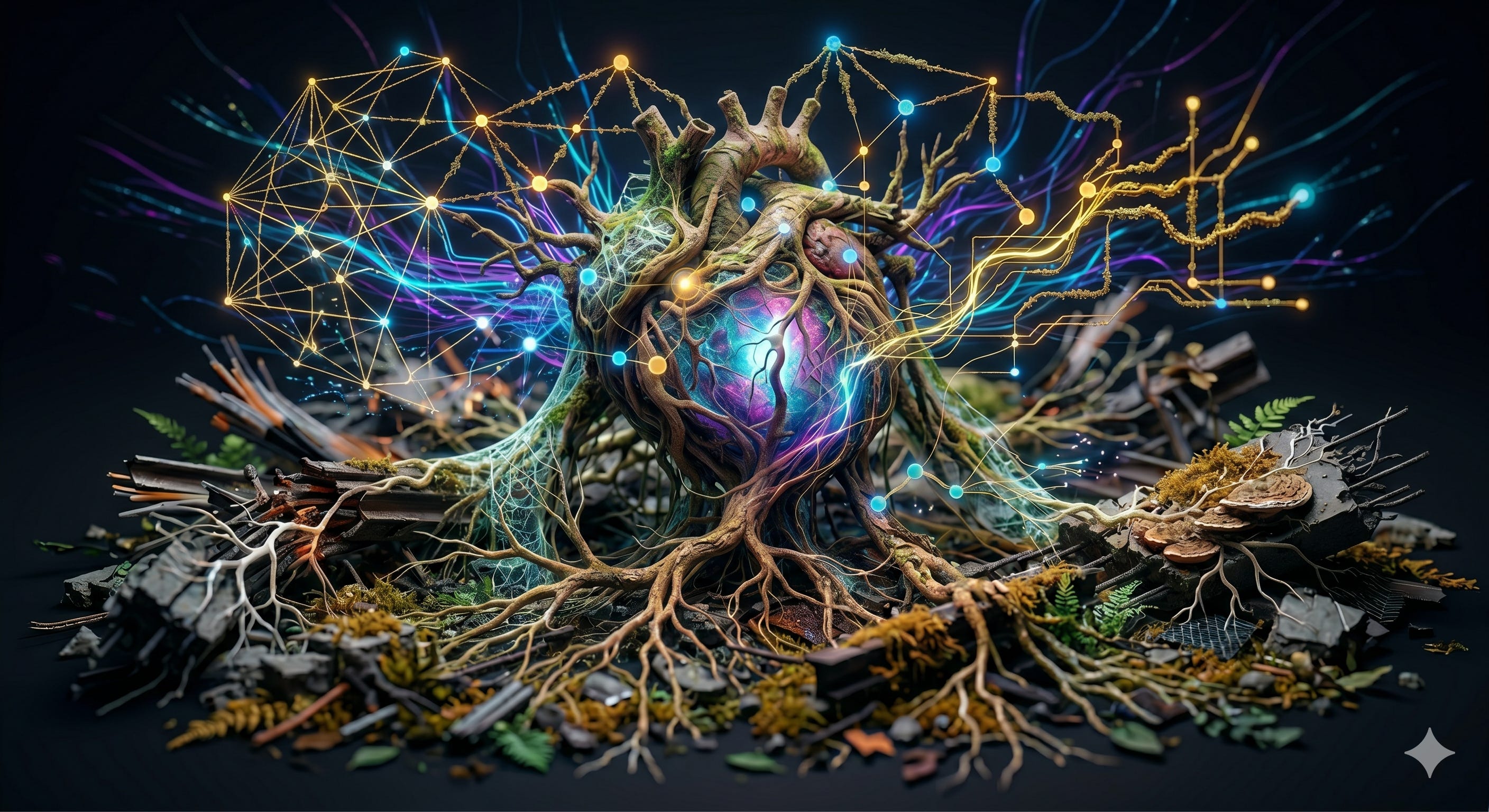
It’s a fractal emergence. Each community has its own integrity, but it’s part of a greater ecosystem. A mycelial network of humans waking up to co-create the future. Because, even though we’ve been lulled into a consuming posture for generations - the future we want is not going to happen TO us. It’s going to happen THROUGH us.
Why Substack?
It didn’t have to be Substack.
Substack is fascinating because it’s both a product of capitalism and a space of resistance within it. Built on a different incentive structure than most social media platforms (subscriptions instead of ads), it allows for longer attention spans and more meaningful relationships. It’s a digital coffeehouse, not just a slot machine.
Because it straddles two worlds, it’s unwittingly become a harbor for generative pockets of truly divergent thought. A virtual bioregion for the mycelial emergence.
It’s like a modern-day salon or a concentrated enlightenment period where people are rapidly spreading ideas. The algorithm prioritizes relative depth and engagement—comments and subscriptions—over just raw discovery. Unlike TikTok, where you have to get somebody’s attention in 3 seconds, Substack allows people to marinate in each other’s perspectives. And it doesn’t unduly punish people for not packaging their perspectives into attention and money generating yet hollow information shells.
To put simply, the marketing bros haven’t invaded and corrupted the platform yet.
And, is it any wonder that the intellectuals and the artists are the ones paving a way forward? Imagination burns at a higher frequency than logic, and certainly fear, which is propagated by other discovery-based platforms. But what makes it have even more traction is the synergy of this and systems thinkers and AI. This is leading to a compounding effect as truly divergent thinkers and builders are able to quickly translate their perspectives and then share them.
That’s why it’s a fertile space for the network to grow for now.
Signs of Collapse—and Emergence
Meanwhile we are living through the time of collapse. (Remember that the etymology of that word means to “fall together”) And soon we will be in post-collapse. Like a fire burning through a forest to reseed the ground.
You see it everywhere now. Tech workers fired en masse. Institutions gasping for credibility. The old world is unraveling. And alongside it, the new world is knitting itself together.
There’s too many signs to count about the old world collapsing. Most recently is the win of Zoran Mamdani—overwhelmingly—who people scream socialist but is essentially just wanting to take care of people. That is the new world emerging. Whereas the old world says socialism is bad, you can’t do this, the billionaires will go away. All of that is not working anymore because too many people are waking up and realizing that the old world never worked for everybody. We only believed it because we believed in the consensus reality. We believed it because our parents told us. We believed it because media told us. We’ve been conditioned to see that this is the best possible outcome when there are far better possible outcomes.
Now there’s a collapse of familiar structures, but also a collapse of meaning. Consensus reality can no longer determine what events mean to us. And at the same time, you see these voices growing in different pockets but are now starting to see each other. The mycelial network has not yet been integrated.
And it’s the people, the connectors, the paradigm translators that get to connect those pieces through bringing awareness, consciousness, through marketing and packaging ideas, sharing ideas, building communication pipelines, etc
It’s Time to Take Radical Responsibility
We are past the era of outsourcing our lives to institutions. Radical responsibility means internalizing that no one is coming to save us—not a politician, not a company, not a hero.
Taking radical responsibility begins when you really internalize that there’s no such thing as a savior outside yourself that is going to make things right. The idea that there is is a comfortable narrative to believe in to deal with the yawning existential void that it means to not have someone come to save you. Which is why a lot of people turn to religion or comfortable ideas about good and evil. The people in power benefit from people thinking that there’s good and evil because it means they can easily paint someone as the evil person and turn people against them.
The other team can make you think you’re playing a different game.
Radical responsibility doesn’t mean taking responsibility for everyone—it means taking responsibility for yourself and the consequences of your actions.
It can be terrifying. But it’s also liberating. Because when you realize no one is coming to save you, you begin to ask: what am I here to do?
Redefining Entrepreneurship for the Parallel Reality
This all sounds great in theory, but it’s actively destabilizing and dissolving our security. That’s because our security was based on the above now outdated paradigms and structures.
So what do we do now?
If you weren’t experimenting with alternative income models before, then it’s time to start learning about them. Jobs may not entirely disappear, but they are quickly losing long-term potential. I expect many will eventually be some kind of entrepreneur—or develop similar skills—from which new community-led businesses will spring forth. If you don’t think you have those skills, other community-focused entrepreneurs will help you or plug you into those systems. Because there will be huge upside in it.
We can’t outsource our career to institutions anymore. We need to take radical responsibility for our future. But after swallowing that bitter pill, many new possibilities open up.
It’s helpful to remember that the middle class is not a fundamental property of society. Before the 20th century, it didn’t exist. You were either noble or peasant, merchant or laborer, land owner or land worker. To climb socioeconomically, you had to start a textile business or find a hopefully handsome baron. The middle class rose from the consolidation of wealth into the upper class and the consequent regulation of that class by the government. This is a clever idea as it keeps a majority of people (wealthy + middle) aligned politically against the poor—keeping at bay revolution. But it has been all but eroded.
The same rules apply now as they did pre-20th century. The middle class is a thing of the past. But unlike the past, that tech access means we can create something completely different—a globally interdependent network of sovereign local communities. We have everything we need to completely change the paradigm of class.
I define entrepreneurship as the creation of new streams of value or chains of value. It doesn’t necessarily mean starting a brick-and-mortar business. It means recognizing where there are opportunities and unmet needs. Because it can be anything, it’s not captured by a central entity. It can be redistributed. It can be used for well-being.
The core trait or mindset that everyone needs to adopt is: I get to create my own job, create my own career. But underneath that is something even more fundamental - we together get to define what value even is.
What I’ve found is that the more I understand my own gifts and utilize them in service, I naturally create value whether structures around me are there to recognize it or not. I believe that when we all do this, we naturally expand prosperity (not just money).
And building from mindsets like these is how we create right relationship in all domains of society.
Conscious Capitalism—Real and Illusory
When I first learned about conscious capitalism, it sounded incredible—purpose over profits. And philosophically, I was all in. But what I saw over time and in practice was the same incentive structures wrapped in a nicer brand. Purpose became a tagline. Consciousness became a commodity.
That was disillusioning. I realized one of my core operating principles - that if a system’s structure doesn’t reflect the intent, the outcome will never match the vision. Good intentions can’t survive bad architecture. Systems shape behavior—even for good people.
This led to a type of disillusionment and a recognition that well-meaning humans are still directed by their reaction to systemic forces. There’s a reason why systems thinkers tend to understand and overlap with each other: once you start seeing life as a system—a relation of interdependent entities—you can’t unsee it. When I became a homeschooler, I went from thinking that the paradigm of education was all of reality to recognizing it was simply a system. Seeing things as a system leads to a kind of disillusionment through distancing yourself.
But here’s what’s important: that distance creates space—for design, for reimagination. The architecture can change.
What’s Coming Next
The new possibilities are manifold. They’re the alternative income systems I described. But more than that, they’re the proliferation of a different kind of belief system that gets to take root in these structures. Some of us need to believe it first to start them. But not all of us need to believe it in order for it to happen.
If community-run grocery stores or government-run grocery stores and free buses happen in New York, they’re going to benefit everyone—not just the people who believed in them and pushed them forward. So it’s going to look like an up-leveled quality of life in every community that practices this.
I think literally anything could be a community-led business. Look at the drivers co-op—that’s Uber but cooperatively owned. The big difference between a traditional business and a regenerative one is that it’s not a singular person or small percentage of people at the top. There are incentive structures that actually benefit more people. They’re more egalitarian, they’re more believable.
Cooperatively owned and then the intent is focusing on bettering the community, not generating resources. Resources are only to better the community, to evolve it. That’s the collective purpose: to increase the quality of life in the community, not to just generate profit. It’s actual conscious capitalism, not the whitewashed version.
These businesses are likely going to be self-organized because the philosophies that are going to be magnetic to value are those that expand and facilitate sovereignty. So they’re going to ask more of you to have autonomy.
We’re going to see more and more social technology that follows these same principles. It’s either going to be open source, it’s going to be federated, it’s not going to be captured in a walled garden. Because eventually people’s collective belief and preference—is going to move away from those kinds of companies. I know that sounds insane when it feels like opposition has all but captured them.
But logically, If you’re in a community and you have two options and one is extractive and the other is regenerative—and they’re otherwise the same—you’re going to support the regenerative. So it’s only a matter of time before regenerative businesses evolve and create their own network that rivals the existing extractive business models.
Where it goes from there is you have interconnected networks. You have people who have shared value systems—like constitutions or things where they say “yeah I agree with these broad set of values.” And then you have networks who can exchange different value across each other.
For example: you go to an eco village resort and instead of paying money you pay in time banking. You volunteer to be at that resort or you exchange some of your own genius or value to them, and then they let you stay for that exchange. That exchange is tracked on a decentralized platform.
This is a super crude example. But the key is that, there will be rapid experimentation with exactly these things.
What if Substack doesn’t like this? Fine, there will be open source Substack clones.
Cloud AI gets restricted? Local AI with peer to peer processing will emerge. Amazon starts a credit system to restrict access? Someone starts an iterative, decentralized bartering platform. They try to shut down the whole internet? We build a new one, one network node at a time that the people own.
The genie is already out of the bottle.
The best practices will be shared and proliferated across this network, leading to a level of iteration and evolution that is truly unprecedented. The last time anything like this happened was the Enlightenment, and in the Enlightenment we didn’t have the internet. So this is: Enlightenment + Internet + AI + the forcing function of the collapse of our society. Several orders of magnitude more disruption.
This is why I agree with AI evangelists talking about how our weeks will start to feel like months then years. Not because of the technology itself - because of the intersection and feedback loops of these factors.
I said this 3 years ago. We will build utopia because we have no other choice.
Transitioning to Our Future
As crazy as it sounds and as much suffering as I see, I’m also...excited. Excited for what lies beyond this disruption to our modern life. The coherence I felt as a child is reflected by systems dissolving and reorganizing themselves.
It is very difficult to recognize that our institutions have failed us. It is shocking. It is the disillusionment of one of the core myths of American society. So just like any disillusionment, it is hard. And I recommend that you go through it in community. You metabolize that grief through community healing, through reaching out, through recognizing that you’re not alone.
The first thing to do - today - is to release judgment because we have internalized so many narratives about what it means to be a productive member of society. That’s a factory-like framing of humanity, which is a serious lack of imagination. Humanity is so much more complex than that. We have this fundamental belief that we need to prove or justify our right to live, which is not how nature works. Nature says: you just are, you just be.
So I invite you to let go of those internalized systems of self-oppression—about productivity, about purpose, about what it means to generate income, about what money means about you, about value. You can let go of those things progressively, compassionately, and allow yourself to believe what truly feels aligned in your heart. And that you can - and the world we want to live in WANTS you to - follow your aliveness. And trusting that right now - many others are doing the same.
We are blindfolded, lifting the veil, calling out. Realizing, we are on the ledge together.
The Role I Play
I’m going through all of this right now. I have just enough clarity to speak from the other side of the bridge. Every day I’m beset by pressures wanting me to prove myself.
But if I’m not the lone genius figuring this all out, then who am I? The idea of being a lone genius is centering. It’s the individualized hero’s journey. But it locates value in consolidation and capture of wisdom. But wisdom is relational. This emergence will not happen because a hero rises to show us the way.
Substack, like every social media platform is built from the broadcast model. So it’s architecture reflects a worldview that says your worth and your security is based on the amount of subscribers you have. But that 1 to many model never fit me, as much as I tried to make it work.
I’m naturally a relationship builder, so I benefit from depth and collaboration. I actively reject surface-level. I want deep relationships that are meaningful and life-giving and mutually beneficial. And when I connect with others, some kind of value is always generated, whether we call it that or not.
And, I want to live in a world like that—one that prioritizes and structures for depth and kindness.
But what do I do? If not capture attention and generate revenue for my platform master.
Well my natural capacity is in language and perception. I’ve been called an infinite dot connector, and I call what I do galaxy braining.
So, in this environment I’ve become a translator between different paradigms. I can read philosophy, systems theory, economics, spirituality—and see how they weave together. I’ve learned that business is at it’s heart relational - the atomic unit is not an incentive flow, it’s a person being changed. And the more sovereign and self-aware people are, the more regenerative the systems they build by default. Extractive systems are at their heart, systems born of separation. The antidote is integration.
Through all this, I realized my gifts activate by approaching a network like a network, not a machine to be optimized.
What about you? What gifts are you becoming aware of, that the world has not designed an environment to reflect back to you, yet?
How can we cocreate structures that do?
Yes-And, Light and Dark
Yes, techno-feudalism is a possibility. So is total Mad Max style societal collapse. But so is emergence. So is utopia.
We live in a Yes-And universe. The dark must be integrated—not ignored. But beyond the darkness is possibility—if we choose it, build it, and live into it.
If you can hold paradox with tenderness and vision, that is a rare and vital skill right now. Though they are parallel, it’s not about choosing one reality and denying the other. It’s about experiencing and not shying away from the darkness, but walking through it. We cannot get there without it.
I choose to believe we’re all here for a reason. We all have a part to play. We all have a genius that longs to be expressed and a context where that expression gets to take root.
This is the moment to plant something real. To use our tools, our genius, our relationships with emerging intelligences, and most of all - our hearts - to co-create a world that works for all beings.
Find the others. Connect the dots. Share your genius.
The mycelium is already growing.
Even though the world of work is dissolving, there are universal unwritten rules that apply in any paradigm of human organization. I spent my entire career uncovering these, and then I wrote a guide about it — most importantly how to navigate without losing your aliveness. It’s called The Invisible Game of Work.
And, if you’re a subscriber and you’d like to read it in exchange for a review, DM me.
"Find the others. Connect the dots. Share your genius."
https://suzannetaylor.substack.com/p/an-old-call-for-a-new-day
Well written and well done!
It does seem like more of us...are seeing more of us. That we've had similar experiences, reached similar conclusions thus far, are a kind of brotherhood and sisterhood scattered across the globe, and even across time and generations. That's what Firekeepers is – the scout troop of those folks, exploring, pioneering, out on that frontier.
We've suspected, questioned, realized, stayed relatively quiet about it, especially after being misunderstood ... because most others just couldn't understand ... 'the emperor has no clothes' ... for going on quite a while by now. And you're right – It is indeed exciting to witness more and more folks coming to see the same thing we've seen...all this time.
Those who have eyes to see, let them see!