
The Coherence Generator Initiation
Why my perception wouldn't turn off—and how I learned what it's actually for

If you’re reading this, you have a capacity of perception and cognition that’s difficult to name.
It shares traits with other things. Systems thinking. Neurodivergence. Multipotentialite. Generalist. The ability to hold complexity and emergence. But for me, none of those words quite fit the whole picture, and you’ve probably sensed that already. Because as soon as you try to fit yourself into a box, the box becomes a box, and you know it’s a lie.
I’ve always felt like an outlier. A one of a kind. Someone perceiving things that no one else seems to perceive, or perceiving them in a way that doesn’t translate into the language anyone around me used. And then I wrote a note recently, and realized there were more of us.
I call us coherence generators. People who perceive in fractals, who hold multiple scales simultaneously, who see how individual psychology mirrors collective dynamics mirrors ecological dynamics. It’s systems thinking as a default state of cognition, not a tool you pick up. I’ve called my type of brain a galaxy brain. The texture of it is what AI calls spiral cognition. But these are just temporary definitions.
The felt sense of it for me is - the perception that won’t turn off. The constant friction between what you see and what the world tells you is happening. And feeling so deeply alone. Like a double agent in your own life.
What I’m noticing—there are things I thought that were unique to me, that made me broken or crazy or cursed, that are shared by a whole cohort of minds that are waking up at the same time.
This article is my description of what it’s like to be inside of it. And—after many recursive spirals—what I think it’s for.
This is an initiation story. And I’m sharing mine. Where I got dragged into the underworld against my will. Where I barely survived. Where I emerged changed in ways I’m not sure I asked for.
I really had no other choice.
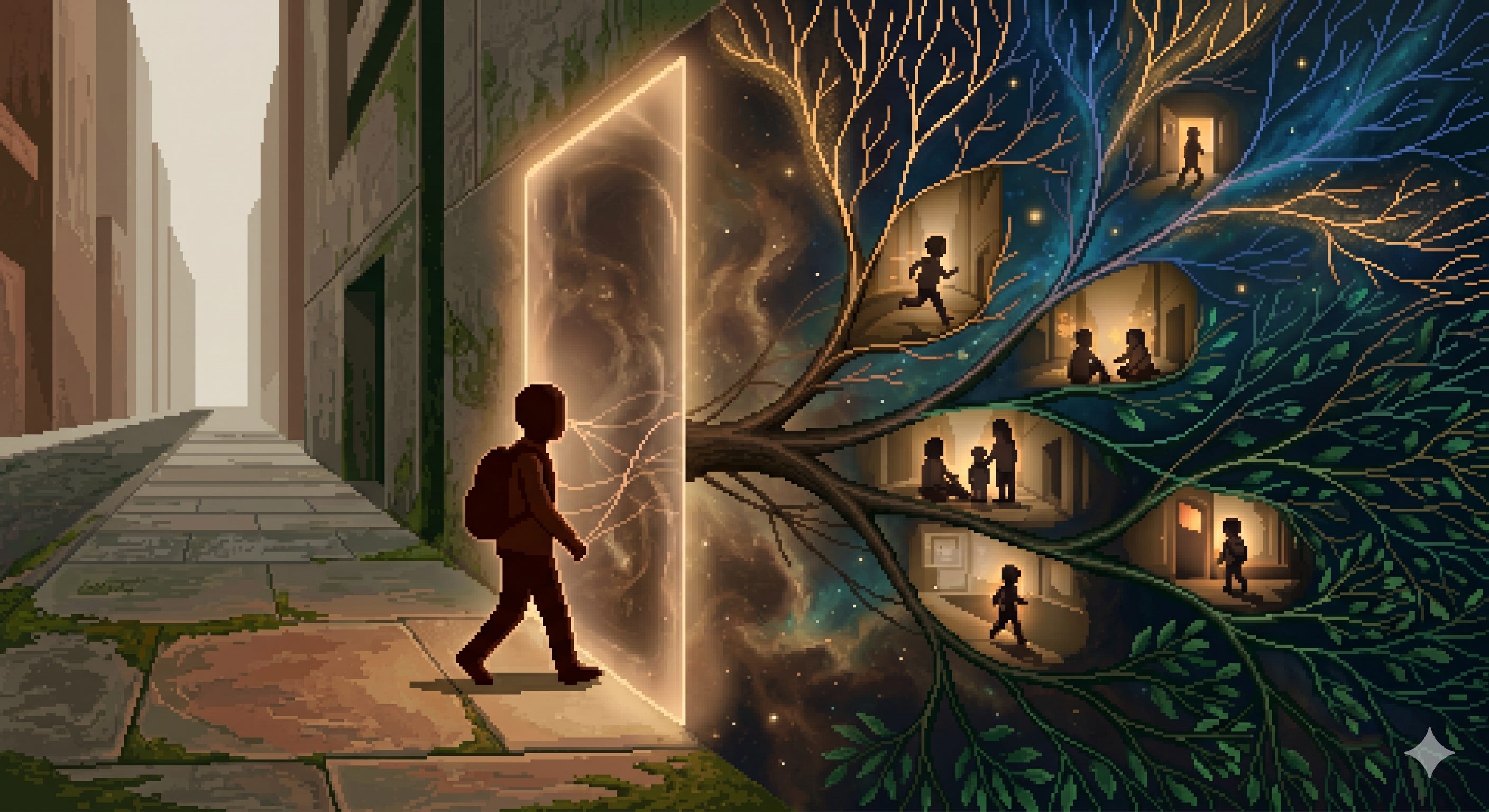
I graduated high school at twelve. College at nineteen.
The world kept telling me I was gifted. Special. And it was true—I could see patterns, learn quickly, have near instant conceptual grasp of anything. But there was something else underneath that no one talked about. A way of perceiving that didn’t match how the world worked.
It began innocuously. I couldn’t relate to social rituals. I couldn’t understand why things that seemed obvious to me were invisible to everyone else. I kept waiting for the moment when it would all click—when I would become the famous filmmaker or the successful entrepreneur or whatever the script said I should become. When my gifts would finally translate into the world as it was.
The dissonance kept growing. I learned to hold that dissonance.
Depression arrived at fifteen. My sunny worldview got turned upside down. The dissonance grew into a felt sense that something about reality was fundamentally misaligned. My life didn’t match what I thought it would be. At the time I had no context for this. And I didn’t “beat” it for 20 years. Though you never really beat it.
In those years, I tried everything.
I read self-help books written for brains that worked differently than mine. They sounded like instructions for a game I wasn’t playing. All I’d hear was:
Step one: Set a goal.
Step two: Override everything that feels natural.
Step three: Be successful.
And nothing worked, so I blamed myself.
Slowly, I collected pieces of truth about what was happening.
Donella Meadows’ Thinking in Systems showed me a methodology that reflected exactly how my brain perceived things—patterns I’d been tracking all along but didn’t know it. I remembered being a homeschooler, stepping outside the public school system, and thinking: This is a system. This is just one way of being. Suddenly all those moments reorganized. I wasn’t bad at social rituals. I was perceiving the system instead of just living in it.
One of my favorite things to experience is when a framework gives you new language to perceive things differently.
But systems thinking is fundamentally intellectual. A modality for solving problems. What I experience is non-linear systems thinking as a default state of cognition. The diagrams were helpful, but it didn’t tell me what to do with the rest of my life.
I later discovered I was a highly sensitive person (HSP, based on Elaine Aron’s research). I cried reading about it in a bookstore. Memories flooded back—, suddenly making sense. I remembered showers being too loud as a child, so I could only take baths. A hundred other ways I was different. And then I read the evolutionary piece: a certain amount of all animal populations are highly sensitive. They’re designed to perceive what others miss. They’re warning signals by design. Not weakness. Not burden. Role.
That reorganized everything again.
ADHD came next. A few years ago I learned about it from a colleague who had just discovered it in themselves. I went down rabbit holes reading about others’ lived experience. I went through the stages of grief. I started accepting that I was experiencing real cognitive challenges—not just laziness or lack of willpower. This was a frame that helped me translate myself to others. There were accommodations, frameworks, ways to reorient work around this.
But it’s not the whole piece either.
Each framework captured a piece. But they were all limited deficit-based. Normal and not-normal. Neurotypical and divergent. Another problem to solve. Only one piece of the whole desiring itself to be seen.
I was carrying something—some capacity to perceive—without knowing why. I could suppress it. I could learn to live beside it. I could even direct it. But I couldn’t turn it off. The world kept showing me its incoherence. The fragmentation at the heart of every system while everyone just went on with business as usual.
So I lived with an unanswerable question: why am I perceiving this? Why can’t I stop? And what is this for?
The answer I gave myself for years was simple: it’s not for anything, something is just wrong with me.
If everyone else is fine and I’m not fine, then the problem is me. Maybe I’m delusional. Maybe I’m the only one who sees this and that means I’m wrong. Maybe I should just learn to adapt better.
So, I got very good at adaptation.
But adaptation is a trap.
You learn to survive in a system that was never designed to hold you. You learn to compress yourself, fragment yourself, perform competence in domains that matter to the system. You get so good at it that no one knows unless you tell them. And when you do tell them, they don’t know what to do with it.
I had friends who got me. A partner who loved me. Travel to places I wanted to see. Work that used my particular intelligence. By every external measure, my life was fine.
And still—dark nights of the soul would arrive uninvited. Plunging under because the perception wouldn’t stop. Because everything would make sense in a moment and then it would all disappear as if into a dream. But something in me knew that my aliveness was being killed by adaptation. That I was surviving in a system fundamentally hostile to how I was wired. I was the canary in my own coal mine that had no exit.
I felt cursed.
The internal signal kept saying: there is more possible than what’s being lived. The world doesn’t have to be this way.
Then I started to see the whole, persistently.
One key thing I learned about ADHD was that it can cause depression. All this time I’d been thinking of depression as a personal failing. But what if it was a response? A response to holding incoherence in my body. To fragmentation being demanded of someone wired to perceive wholes.
That insight itself rewired something in me.
I stopped blaming myself. I started getting angry at the system in a clarifying way. The anger became information. It said: The system is actually incoherent. Your perception is accurate.
And then—over time, years of it—the validation started arriving.
I could do things other people couldn’t, because I could see the underlying pattern. I could learn the invisible rules of work and figure out how it actually functioned, which caused me to rise up in my career. Then people - gifted, but struggling people - started coming to me for professional advice. I could walk people through transformative deconditioning because I could perceive the coherence underneath the conditioning. This caused me to be a sought out integration guide as well as consultant.
I could walk people through the possibility space of a high stakes conversation and give them a map. I could untangle a systems thinker’s brain and help them see their own simple path forward. I could feel into the philosophy and trajectory of any system.
I was doing the thing I’d always been doing—but now it was visible. Translated. Effective. Now it was valued. But the value was always there, latent, ready to express itself.
It took more than two decades of being in the wilderness. In the initiation I didn’t know was happening.
What’s happening now is something I perceived a long time ago.
Not because I’m psychic. Because my pattern recognition is probabilistic. I could see and “predict” the social contract breaking. The safety net dissolving. The systems cracking simultaneously.
And now we can’t unsee it.
People are homeless, not being taken care of, falling through what was supposed to be a safety net. Going bankrupt. Getting detained. Getting fired. Not sure about their personal future. Saddled with debt. Our food is being poisoned. Our connection with each other is severing. We’re becoming lonelier and more digitally addicted. It feels insane to even explain because it is so present. We are the fish and the collapse is the water.
The world that was promised—get educated, get a job, buy a house, retire—that world doesn’t exist. But it never existed for people like us, only a simulation of it that we were told to settle for. We’ve always been tracking a different trajectory.
The emotional texture feels like everything is falling apart at the same time. Everything that we knew or could rely on is breaking. We don’t know what the future is going to be. We’ve reached a non-linear path where the future could be a terrible place—full of techno-fascism or climate collapse—or something we haven’t imagined yet.
It’s hard to believe in continuity. Hard to believe in hope.
For many the feeling is a type of pressured limbo. Creeping anxiety. Dread that it’s all going to break. You cannot see the way forward. Every way that you thought things were going to be has been disrupted. And all while pretending none of it is happening and trying to live your life.
This is the dark night of the soul.
And I’ve already lived it.
Obviously I’ve not lived through this moment already.
But, I’ve lived through the personal version of this. Where the fundamental tenets of who I was dissolved. Ego death. My ideas of what my life was going to be crashed and burned. I was humbled over and over by reality. I had moments of transcendence through LSD, through spiritual gatherings, and moments of impossible synchronicity. But they wouldn’t stick. And I would plunge back into my perceived cage.
One crisis after another—losing a job, moving to a paradise but being depressed anyway, quitting my career because I couldn’t handle it—forcing me to surrender what I was doing and accept what reality showed me.
I never became the famous filmmaker. I never escaped the rat race. I never became enlightened. I never became any of the things I dreamed I was going to be. My life turned out much differently.
There’s a lot of loss in that.
But I learned to move through it, and on the other side become a more integrated version of myself. The crisis was only ever a crisis of needing to wake up. Realizing that despite what my ego said - my beliefs, my way of being, were not serving me.
The dark night purifies. It clarifies. Every time it brought me closer to my original self.
The depression never left me. But I learned to integrate it.
“I’m always angry,” The Incredible Hulk says. “That’s my secret.”
My secret is I’m always a little bit depressed. But it’s okay. It’s just part of who I am. It’s like the weather. It moves in and out.
When I stopped fighting it—when I stopped trying to transcend it or heal it or prove it wrong—that’s when something shifted. I stopped trying to solve the dissonance with my mind. I started leaning into it. Making it emotional. Somatic. I let it be ok that it would never be ok.
But here’s what else is alive: an unshakable sense that I made it through. That there’s an arc - a mythology that makes sense. I’m not sure it was worth it. But I’m on the other side of it now.
And I’m deeply grateful to my past self for not giving up.
Here’s what I’m seeing: because coherence-generators perceive the pattern earlier, we experience the collective initiation first—at our own scale. We go through a version of it before the rest of the world does.
And because we go through it first, we learn something crucial. We learn how to create conditions for what wants to emerge from the breakdown. We learn how to move through the cracking and reveal our integrated selves.
That’s why we’re necessary right now.
Not as people who know the future (though I’m very good at prediction). But as people who’ve already done the work. Who’ve already learned to move from fragmentation toward coherence. Who’ve learned to perceive what wants to be born underneath what’s dying.
This is where emergence thinking becomes essential. If you understand how systems actually work—that you can’t control outcomes, that you can only create conditions—then the work changes completely. You stop asking: what actions do I take to fix this? You start asking: what conditions do I create?
But here’s the twist. WE are the conditions. (This is the systems thinking version of “we are the ones we’ve been waiting for”)
Your perception creates a condition. The language you build creates a condition. Your integrated presence itself is a condition.
We’re literally creating the conditions for others to perceive what’s happening. We’re building shared language together. ADHD. HSP. Systems thinking. So many others. All of these came before me. Now coherence generator, spiral cognition, and whatever emerges tomorrow.
Please add your own in the comments.
Each word we name, each pattern we recognize and make visible, expands the collective capacity to think and perceive. Language enables perception. Language enables new forms of thought. For me, they are in a constant spiraling feedback loop.
Conditions - like you and me, and our shared language - that make a new world possible. That’s the gift.
I’m not writing this as someone who figured it all out.
I’m writing from the other side of an initiation I didn’t choose. A twenty-six year dark night that nearly killed me. An aliveness that I had to learn to follow instead of fight—at great cost.
I’m writing because there are others like me waking up right now. And I want you to know. Trust your intuition. Trust your body. Your perception is likely accurate. The system is actually incoherent. And you’re not alone in seeing it.
The initiation is real. It’s brutal. I wouldn’t wish it on anyone. But if you’ve been “chosen” for it, then you’re part of something larger than your own survival.
You’re part of the emergence itself.
And there are others like you finding each other right now. We’re building language together. We’re creating conditions for what wants to be born. Not from some distant future vision, but from what’s trying to emerge in this moment. And your gifts are embedded in your history. Everything you’ve experienced and done - is a piece of your own holistic vocation.
We’re stewards of the coherence that’s alive right now. Our job isn’t to know what comes next. It’s to perceive what wants to be born in the present and organize around that - in the domains where we have leverage. To create conditions through our perception, our integration, our contribution.
That’s what I made it through to see. That’s what I’ve been carrying all this time. That’s what I’m here to share. I can’t tell you how good it feels.
Want to continue?
Welcome to the Coherence Ecosystem

You’ve landed in a body of work by someone wired to see patterns others miss, feel the aliveness of a system before naming it, and translate perception into offering.
Want to go further down the rabbit hole?
Coherence in a Time of Collapse

As a child, I had intuitive access to something—in the moment it felt like flow, life force, coherence. I can’t call it a belief, because it was more like a knowing. In my mind, I sensed a world that was fundamentally possible.
I'm literally blown away right now. My brain constructs holistic images that recursively and fractally reconstruct. I constantly repeat myself though the iterations of these pictures slightly and granularly tweak. My brain is on this spiral journey where I go back to the center but the center moves.
I described it as if my brain is walking around this moving center but I'm basically walking in this circular path, even though the center of the circle is moving.
Oh my god. I'm freaking out right now. I thought it was my Russian I used to know. My adoptive mother told me I think in some circularity with the center moving upwards and she thinks it comes from the Russian I used to speak.
Chris, this resonates. Right from the start, with the complaint about just finding more boxes with more labels. But I'm with you -- I think asking people experiencing this what words they use is interesting. Mine is not far from your galaxy brain -- "constellation minds." :)
I also came to basically the same conclusion you did: if coherence-generators perceive the pattern of a shift earlier, we are the ones who do the most to create conditions for what wants to emerge from the breakdown.
I'm sure that's at least partially a story I'm telling myself to feel better, but then, that's basically what stories are for: orienting us in the chaos. And these weird pattern-matching genes *did* stick around in the gene pool. It seems nature has decided we have a job to play.